
Big pharma buys biotechs constantly, and every deal starts the same way: a small group inside the buyer learns the target’s name weeks before Wall Street does. For the SEC, that window is one of the most reliable places to find insider trading. The people it catches there are rarely CEOs.
The AstraZeneca due diligence case
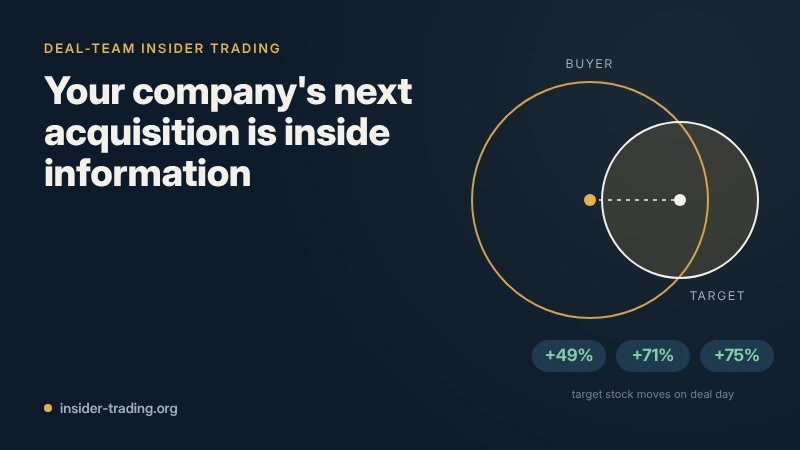
In July 2026 the SEC filed settled charges against Weiguo Zhai, an AstraZeneca employee who served on the team evaluating Icosavax. According to the SEC, he bought Icosavax shares in his wife’s brokerage account before AstraZeneca announced its tender offer on December 12, 2023. Icosavax stock rose about 49% on the news.
The proposed judgment orders him to pay $10,006 in disgorgement, $1,535 in interest and a matching $10,006 penalty. The profit was small, and the SEC still brought the case more than two and a half years after the trade.
The Bristol Myers Squibb treasury case
Bristol Myers Squibb has its own history here. In 2012 the SEC charged Robert Ramnarine, who worked in the company’s treasury department, with trading options in three companies BMS was evaluating or acquiring: ZymoGenetics, Pharmasset and Amylin.
The SEC alleged more than $300,000 in profits between 2010 and 2012 and asked a court to freeze his brokerage accounts. Federal prosecutors in New Jersey arrested him the same day. He was not a dealmaker. He simply worked close enough to the deals to see the names.
2026: the pattern keeps repeating
- Jazz–Chimerix. Weizheng Zeng sat on Jazz Pharmaceuticals’ due diligence team. The SEC says he bought nearly 20,000 Chimerix shares across six accounts in the two weeks before the March 5, 2025 announcement. Chimerix closed 70.57% higher. He settled in April 2026, paying $69,011 in disgorgement plus a matching penalty.
- Supernus–Adamas. In September 2026 the SEC sued Mukesh Asudani, a former senior vice president of human resources at a drug company that was bidding for Adamas. The SEC alleges he learned of the bid in internal meetings, sold his entire stake in his employer and bought Adamas, including through accounts belonging to his son and a family friend. Adamas rose about 75% when Supernus announced its deal. The case is being litigated, and the allegations have not been proven.
Note one detail in the Asudani case: his employer lost the bidding. The information was still inside information.
Why these cases are easy to spot
Tender offers fall under SEC Rule 14e-3. It bars trading on nonpublic information about a pending tender offer that came from the bidder or the target. Unlike most insider trading cases, the SEC does not have to prove a breached duty of trust.
The trades also stand out. Targets in these cases jumped roughly 50% to 75% overnight. The SEC’s Market Abuse Unit runs data analysis built to flag exactly that: well-timed purchases, short-dated call options and accounts with no history in the stock.
Using a spouse’s, child’s or friend’s account does not hide anything. In the Zhai and Asudani cases, it became part of the SEC’s story.
What it means if you work for an acquirer
You do not have to be on the deal team. A town hall remark, a calendar invite, a finance request or an HR planning meeting can put you in possession of material nonpublic information. If you hear a target’s name before the press release, the safe trade is no trade: not in the target, not in your employer and not through anyone you know.