
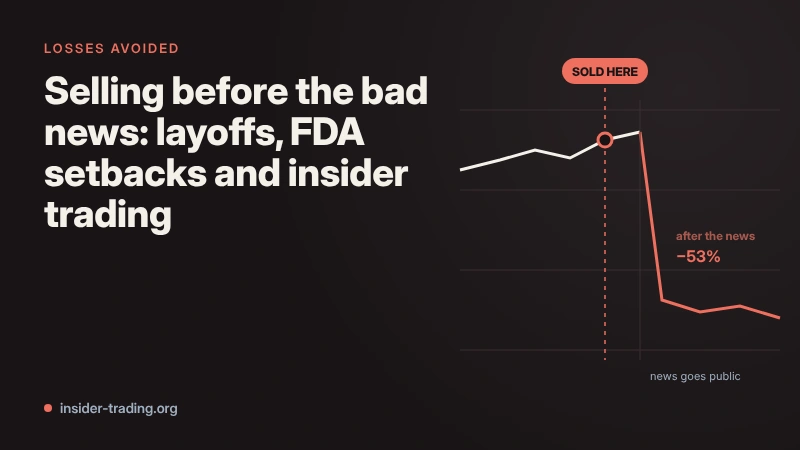
Most people think insider trading means buying before good news. Many recent SEC cases in pharma are the opposite: someone hears about a layoff, a failed trial or an FDA setback and sells before everyone else can. The SEC calls this “losses avoided,” and it treats it exactly like profit.
When the layoff plan is the inside information
In August 2022, Doximity’s chief revenue officer, Paul Jorgensen, sold 61,162 shares ahead of a quarterly earnings call. According to the SEC, he knew three things the market didn’t: sales were coming in below expectations, the sales team was underperforming, and the company was planning a reduction in force.
The SEC put his profits and losses avoided at about $2.53 million. He pleaded guilty to securities fraud in January 2026 and settled the SEC’s civil case in March 2026.
A smaller case shows how fast these trades happen. Matthew Groom, an IT consultant for Spero Therapeutics, learned on a March 30, 2022 call that Spero planned to suspend commercialization of its lead drug and cut its workforce. He sold all his Spero shares about 21 minutes later. When Spero announced the news on May 3, 2022, the stock fell 64%. He avoided about $13,000 in losses and paid about $28,000 to settle.
When the FDA says no
- ImmunityBio. Caroline Campbell, an ImmunityBio employee, learned on May 9, 2023 that the FDA would delay approval of the company’s bladder cancer drug Anktiva. She sold 48,495 shares over two days. The delay became public on May 11, and the stock fell about 55%. She settled in April 2026, paying back $157,066 in losses avoided plus interest and a matching penalty.
- Sage Therapeutics. On August 4, 2023, Sage announced that the FDA had denied approval of its main depression drug candidate, and the stock fell 53%. The SEC has since settled with two people who allegedly sold early on a tip from a Sage insider: Brian Suthoff in January 2026 ($19,680 avoided, plus a five-year officer and director bar) and Cheryl Kramer in September 2026 (about $11,140 avoided).
None of these amounts would change anyone’s life. Each still ended in a federal case.
The Pfizer case: the same mechanics, in reverse
Pfizer employees will remember the counterexample. In June 2023 the SEC charged Amit Dagar, a former senior statistical programming lead at Pfizer. It alleged that on November 4, 2021, the day before Pfizer announced its Paxlovid COVID-19 trial results, he bought short-dated, out-of-the-money Pfizer call options. The SEC said he made about $214,395, a one-day return of 2,458%. Federal prosecutors filed parallel criminal charges.
Good news or bad news, the rule is the same: if you know it before the market, you can’t trade on it.
Why this matters more in 2026
On August 31, 2026, the SEC and the FDA signed an agreement that lets the FDA share nonpublic information with SEC enforcement staff. That makes it easier to prove exactly when an FDA decision existed and who traded before it became public.
Restructuring adds a second risk. During cost-cutting, more employees hear about site closures, program cuts and sales force reductions before they are announced. Selling your own shares or ESPP stock because you know layoffs are coming can be insider trading, even if you are one of the people being let go.
The bottom line
The SEC does not need a big number. It needs a sale that lines up with nonpublic news. Penalties can reach three times the loss avoided, on top of paying the money back. If you know about a layoff, a trial result or an FDA letter before the press release, wait until it is public.