
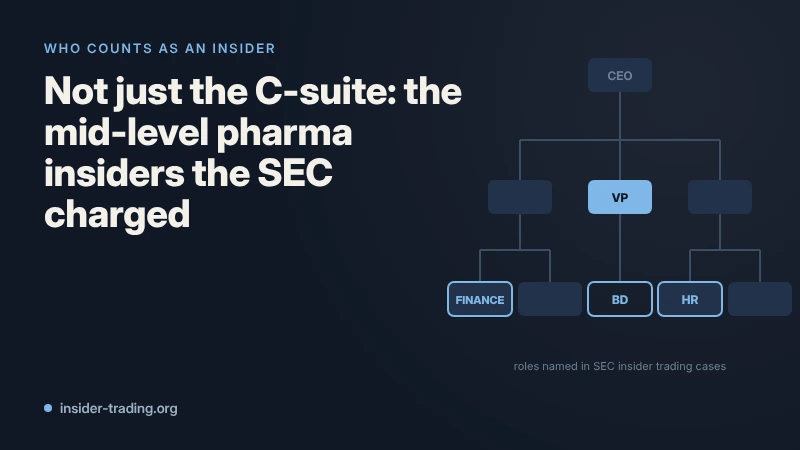
When people picture pharma insider trading, they picture a CEO dumping stock. The SEC’s case files tell a different story. Most defendants are directors, analysts, vice presidents and outside contractors: people with one piece of inside knowledge and a brokerage app.
One Merck deal, a string of cases
In February 2021 Merck announced a tender offer for Pandion Therapeutics, and Pandion’s stock rose about 133%. That single deal produced several separate insider trading cases.
- A Merck regulatory VP. Nirdosh Jagota, then vice president of global regulatory affairs, bought Pandion shares on February 9 and 17, 2021, days before the February 25 announcement. He settled with the SEC in July 2023, paying back $39,660 in gains plus interest and a matching $39,660 penalty. He also accepted a three-year bar from serving as an officer or director of a public company.
- A supplier’s quality VP. Donna Matuizek was vice president of quality at a key manufacturing supplier to Pandion. She bought Pandion stock on February 16, 2021, and settled in January 2023 for about $57,300 in total payments.
- A partner’s deal binder. The SEC also charged Seth Markin, a former FBI trainee. It alleged he read a binder of confidential deal documents belonging to his romantic partner, an associate at a law firm working for Merck, and then traded and tipped friends. Press reports put the alleged gains across that group at well over $2 million.
None of these people ran Merck or Pandion. One worked in regulatory affairs, one in manufacturing quality, and one simply lived with someone who had the paperwork.
The Merck financial analyst
In 2014 prosecutors charged Zachary Zwerko, a former Merck financial analyst. They said he used his access to internal company information to tip a business school classmate about Merck’s interest in Idenix, which Merck bought for $3.9 billion, and about bidding for Ardea Biosciences, which AstraZeneca won. The SEC said the friend made at least $722,000.
The Takeda licensing director
In 2012 the SEC charged Brent Bankosky, a director in Takeda’s global licensing and business development unit in Deerfield, Illinois. The SEC said he bought call options in companies Takeda was negotiating with, turning about $37,000 into more than $63,000 in profits. He agreed to pay more than $130,000 to partly settle the case without admitting or denying the allegations.
Business development is where licensing deals, partnerships and acquisitions start. It is also one of the most information-rich jobs in pharma.
2026: now it’s human resources
In September 2026 the SEC sued Mukesh Asudani, a former senior vice president of human resources at a drug company that was bidding to acquire Adamas Pharmaceuticals. The SEC alleges he learned of the bid in internal meetings he joined remotely, then bought Adamas for himself and through his son’s and a family friend’s accounts. Adamas rose about 75% when Supernus announced its deal for the company. The case is ongoing and the allegations are unproven.
Who counts as an insider?
Under the law, title doesn’t matter. Insider trading is trading on material nonpublic information in breach of a duty of trust: to your employer, a client, or the person who confided in you. That covers:
- regulatory, finance, BD, HR and IT staff who see deal or FDA information
- suppliers, consultants and contractors under confidentiality agreements
- spouses, partners and friends who learn it from any of them
If your job puts you near a partnership, an acquisition, a trial readout or an FDA decision, you are close enough to be an SEC case study.